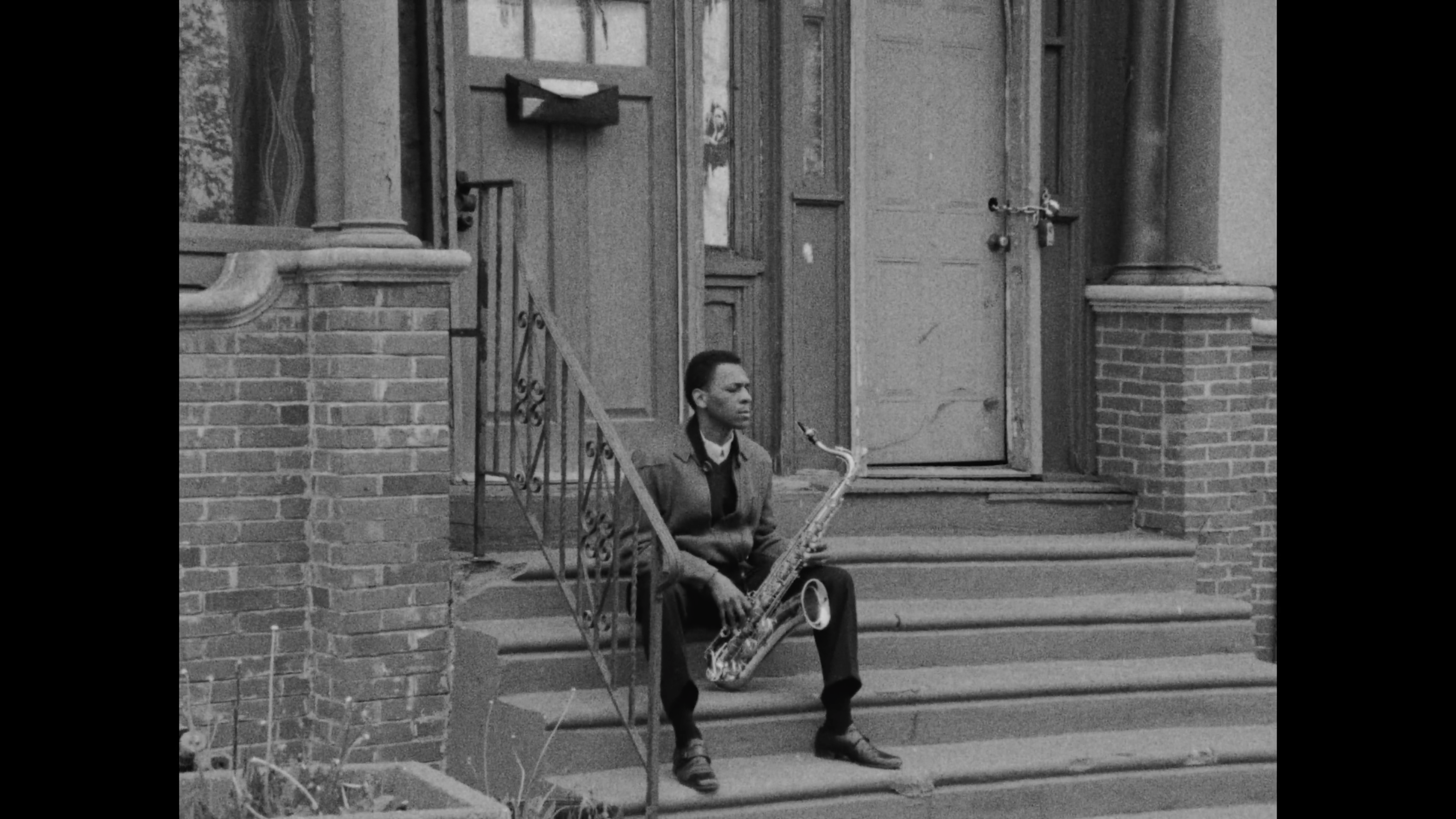
Written by Anyabwile Love and directed by Shahkeem E. Williams, Speakn’ Trane is a 2024 narrative short film that wrestles with both the metaphysical strivings and Earthly realities of jazz’s greatest innovator, John Coltrane. Just 18 minutes long, the film is an understated and contemplative work. Eschewing the traditional biopic structure and conventions, Speakn’ Trane captures the spirit of Coltrane at his most enigmatic.
Sometime in the early 2000s, writer, filmmaker, and Black studies professor Anyabwile Love found himself face to face with legendary jazz pianist and harpist Alice Coltrane. A devotee and appreciator of her late husband, Love took this opportunity to gain some personal insights about the enigmatic saxophonist.
“I met Alice some years ago at Joe’s in New York. I snuck backstage and asked her, ‘What can you tell us about your husband?’ And so for me, that’s the mantle that I walked with. She said, ‘If you’re here, and you know his music, step away from his music. Go study who he was, philosophically and spiritually. Come back to his music, and you’ll understand what he was doing,’” Love says.
In the immediate aftermath of his death in the summer of 1967, John Coltrane was elevated to the status of a paragon of jazz’s highest musical and spiritual ambitions. In an outpouring of grief and adoration that continues today, Coltrane’s peers and followers have created countless compositions, poems, paintings, films, and books dedicated to his memory. In San Francisco, Franzo W. King and his wife, Marina King, took this devotion to the spiritual legacy of John Coltrane even further: they founded the St. John Coltrane Church the year of his death, a religious and cultural institution that survives to this day.

Speakn’ Trane exists in this tradition of spiritual reverence and tribute. The film opens with a scene depicting actor Cameron André as John Coltrane, wandering alongside a river bank accompanied by nothing but the sound of a lone saxophone improvising at length. Shot in black and white on 16mm film, this scene feels like archival footage. There is no dialogue or interactions with other characters; we just follow Coltrane as he appears to be lost in thought with the music swirling all around him.
When asked about the origins of the film, Williams says that he was brought on to work as director and cinematographer after seeing Dear Listener, a play that Love is developing about Coltrane’s life and work. Williams says, “So originally, this film was derived from a play that Anya was working on. I had [the] pleasure of seeing it while it was a work in progress. He came to me about the idea of turning part of the play into what is known as Speakn’ Trane right now. Anya wrote the screenplay, [taking a piece from the play], and came up with this beautiful piece around Coltrane.”
Love elaborates, explaining that Dear Listener and Speakn’ Trane were intended as dramatizations of the period right before the release of Coltrane’s greatest musical offering. He shares, “Dear Listener is set at that pivotal moment in Coltrane’s life when he had recorded A Love Supreme, but not yet released it. This is all fictionalized, but in terms of the setting, he’s in Philadelphia. He’s already moved to Dix Hills, Long Island with Alice, but he’s temporarily back in his crib on 33rd Street while performing in Philadelphia. And as these things go, he’s home, he’s chilling with family, Cousin Mary is still living there. Most of his things have already been moved to Long Island, but there’s still stuff in his room, so he’s going through boxes. And anybody that has moved knows when you’re unpacking or packing, it just takes you down memory lane. The thing that is moving the play is Coltrane realizes he’s going to be pivoting into this other space of his life, musically, sonically, spiritually and philosophically, and that’s what’s coming through A Love Supreme. His concern is, is his audience ready?”

The film handles this transitional period in Coltrane’s life with care and empathy. Shot here in Philadelphia, Speakn’ Trane also points to the city as a key catalyst for his musical and personal development. After moving here from North Carolina in 1943, Coltrane fell in with the city’s vibrant jazz community and built strong bonds with the musicians here.
Love says that Philadelphia was an integral element of the film, adding, “We wanted to set the story here to show his return home being a reminder of this and a space where he could reflect on the next phase of his musical journey. Shahkeem speaks about it as his Sankofa moment.”
In addition to playing with Philadelphia-based peers such as Odean Pope and McCoy Tyner, Coltrane learned and studied under mentors, including guitarist Dennis Sandole and pianist Hassan Ibn Ali. As author and religious studies scholar Richard Brent Turner points out in his book Soundtrack to a Movement: African American Islam, Jazz, and Black Internationalism, the city of Philadelphia was also crucial to John Coltrane’s spiritual evolution. “Because he lived with a Muslim spouse and stepdaughter and had many Muslim friends in Philadelphia, John was undoubtedly exposed to the five pillars and the religion’s basic articles of faith,” Turner writes.

Speakn’ Trane explores the themes of spirituality, purpose, and audience expectations through an interview between André’s Coltrane and journalist Regina Blackwell (played by Imani Palmer). Shot in the black box theater at Community College of Philadelphia, the interview portion of the film brings us into an intimate, thoughtful exchange between Coltrane and Blackwell. When the subject of A Love Supreme comes up, André’s words–written by Love–speak to the intention that Coltrane poured into the album: “There’s a lot of evil in this world and I want to be the opposite. I want my life and my music to be the opposite.”
Fittingly, the interview and film close with a subtle callback to the insight Love sought from Alice Coltrane backstage at Joe’s, decades ago. Blackwell asks John Coltrane if there’s an album that fans can listen to to get to know him as a person. André as Coltrane is reserved, preferring to keep the answer open-ended and himself a mystery. He says, “That record hasn’t been made yet. I’m getting closer with every new recording, you know? Still figuring it out.”
cinéSPEAK is screening Speakn’ Trane on Monday, April 13 at 6 PM at Two Locals Brewing Company. John Morrison will host a Q&A with Anyabwile Love after the screening. RSVP to reserve your spot.
*Featured Image: Still from Speakn’ Trane. Photo credit: Shahkeem E. Williams.

John Morrison is a writer, DJ, and radio host from Philadelphia. His work has appeared in NPR Music, Red Bull Music Academy, Bandcamp Daily, and more.