cinéSPEAK Under the Stars, an annual outdoor film festival at Clark Park, will commence this year on Friday, May 29th with two films centered on community care.
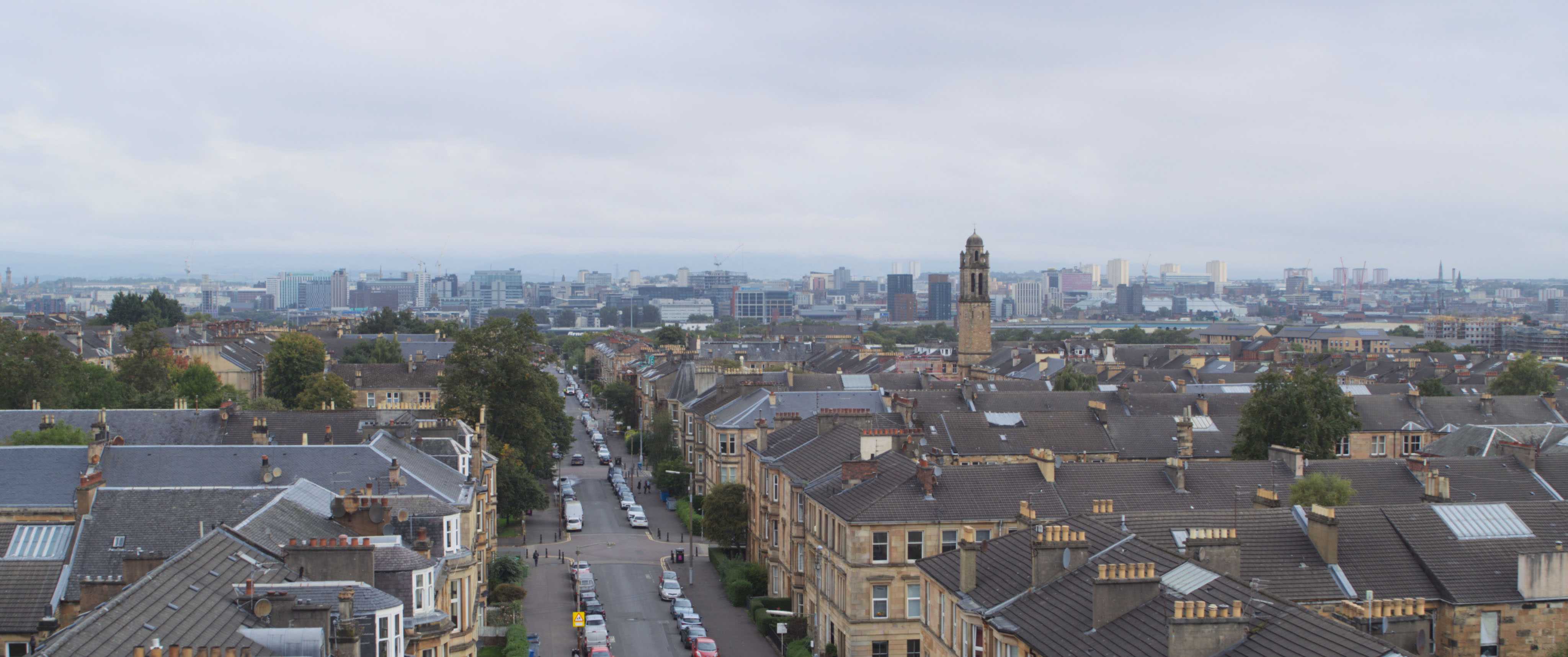
Everybody to Kenmure Street, directed by Felipe Bustos Sierra, is a feature-length documentary film focusing on the impromptu mass demonstration against an immigration raid that took place in 2021 in the Pollokshields neighborhood of Glasgow, Scotland. Two men were forcibly removed from their apartment on Kenmure Street and detained in an Immigration Enforcement van. The film compiles footage from multiple news, journalistic, and individual sources, along with reenactments by actors based on eyewitness accounts, to construct an accurate timeline of the approximately eight-hour standoff.
Also interspersed throughout the film are montages of older footage capturing Glasgow’s history, including past social and political movements as well as Glasgow’s connections to the Atlantic slave trade and slave plantations. It specifically highlights how the profits Glasgow made from importing vast amounts of slave-produced sugar and tobacco dramatically shifted the city’s economy and funded urban construction.
As one historian interviewed in the film says, “Glasgow is a city of paradox. We like to think of ourselves as a city that’s anti-racist, that’s radical, that’s willing to stand up and protest for people’s rights. But on the other hand, we’re also a city that was built off the back of enslaved and chatteled African people.”

This paradox serves as a backdrop to the Kenmure Street protest. Slavery and other systems of exploitation have shaped the structures of modern imperialism that produce the conditions forcing people to leave their home countries in search of safety, political stability, and economic opportunity—only for their newly built lives to be disrupted by these same imperial governments. Bustos Sierra shares, “People know creating safe spaces where families can thrive wherever they come from is the way forward. Nobody uproots their entire family, taking them on an often unsafe journey, on a whim. It’s a matter of life and death, and on Kenmure Street, this wasn’t even a question. They offered their help because it’s the right thing to do.”
Central to the documentary are the two detained men whose faces are unseen for nearly the entirety of the film. The majority of the protesters who showed up on Kenmure Street had no idea who they were. One of the men shares that an immigration officer asked him, “Who are you that all these people have gathered here? In Pollokshields, who are you?” He responds saying, “I’m nobody. I’m normal,” offering viewers a poignant reflection on what it means to stand up for ordinary strangers.
Another layer of context is that the immigration raid occurred on Eid al-Fitr near a Pollokshields mosque attended predominantly by South Asian Muslims. Many of the people partaking in religious services that morning saw what was happening and became a driving force for spreading the news of the raid, allowing the protest to grow exponentially. Though not a focal point in the film, a powerful takeaway is the solidarity that emerged across the South Asian community—particularly given that the detained men, Indian nationals active in their local Sikh community, were supported by many Muslim people celebrating Eid that day.

“Every atrocity across the globe has always started with the othering of groups of people,” says Tabassum Niamat, a trailblazing leader in the South Asian community in Pollokshields who was one of the first protesters to show up at Kenmure Street upon hearing about the raid. “We’ve seen this happen in other places. We know where this leads to. And all of us that have any influence, power, or privilege—we should use it to protect those who are the most vulnerable in society…because none of us are safe in this kind of system that blames or scapegoats people.”
Niamat works closely with refugees, asylum seekers, and migrants in her role as Executive Director at Bowling Green Together, an organization that expands access to green spaces for marginalized communities and supports cultural programming to foster connection and belonging. “I never want anyone to feel despondent or like it’s a losing battle,” she says. “The documentary is so important. Our movement is so important.”
The film also draws a striking parallel to a 2005 political campaign in which seven high school students—known as the Glasgow Girls—saved their friend and her family from deportation. By raising awareness around the poor treatment of asylum seekers, they helped end child detention in the UK. The film opens with a cover of the Lee Hazlewood classic “Your Sweet Love,” reimagined with female vocals as a nod to the Glasgow Girls and to a broader lineage of women-led movements in Scotland—an intentional choice that underscores, as Bustos Sierra notes, how “historically, it’s always been women and migrants at the start of any resistance movements.”

Preceding the screening of Everybody to Kenmure Street is the short documentary Barriga Llena, Corazón Contento (Full Belly, Happy Heart), directed by Jordana Rubenstein-Edberg and Marshall Hanig and written by Natalia Fuentes Amaya. Centered on the Fenix Community Fridge in Ridgewood, Queens, the film explores the evolution of a grassroots food pantry launched in response to the COVID-19 pandemic into a vital mutual aid hub that feeds thousands of families across New York City each week. Through intimate conversations with organizers and community members, it uncovers the often unseen labor that sustains the initiative—nourishing the community with not only food, but also knowledge and communal care.
Developed through the UnionDocs Collaborative Studio Fellowship, the film’s structure is guided by rhythm, repetition, and collective storytelling, with recipes surfacing as a recurring motif. Though composed from footage gathered across multiple free food markets over the course of several months, the narrative is framed within the arc of a single day, from early morning food pickups to evening distribution. As the makers of the film spend time with the organizers, it becomes clear that many arrived at this space through deeply personal journeys, often marked by grief and loss. Each story relates to the next, revealing a community rooted in interdependence.

“Amid rising attacks on immigrants and the erosion of social safety nets, we wanted to tell a story that uplifts the power of grassroots care—where food becomes both sustenance and solidarity. The title, Barriga Llena, Corazón Contento (Full Belly, Happy Heart), speaks to this dual nourishment,” shares Rubenstein-Edburg, who is based in Philly and will be present at Under the Stars.
Attend the first screening of this year’s Under the Stars festival on Friday, May 29, 2026 at Clark Park, and witness the Philadelphia premieres of these two moving films. Prior to the screening will be a performance by Mariposas Galácticas and a set by DJ Ripley starting at 7 PM. RSVP for free to receive up-to-date information and discounts at participating businesses.
*Featured Image: Still from Everybody to Kenmure Street. Image credit: barry crerar.

Sophia Pradhan is a Malayali American artist and arts administrator whose writing explores film at the intersection of cognition, futurism, and speculative imagination. She is especially drawn to cinema that centers memory and ancestral knowledge to envision liberatory futures, with a focus on South Asian and diasporic filmmakers. Sophia is a 2026 cinéSPEAK Philly Cultural Critics Fellow.