This article is part of a column called Philly Profiles, which features in-depth profiles of local moving-image artists and cultural workers, including their body of work, inspirations, and upcoming projects. The column is written by cinéSPEAK Philly Cultural Critics Fellows.
For the past few years, Philadelphia-based archival researcher and filmmaker Christina DiPasquale has been dedicated to one continuous mission: bringing to life the untold story of Realidades, the first Latino television show in American history. Created in the 1970s by a group of maverick Puerto Rican artists and activists, Realidades was the first bilingual TV show broadcast in the New York tri-state area. Covering the political, social, and cultural happenings from the Latino community in New York City, Realidades had a guerrilla approach to television—it was made by self-taught media makers, counter-cultural, and decidedly free.
Even before she discovered the details of the show, DiPasquale was captivated by the radical spirit of Realidades. A talented artist with an extensive background in communication strategy, policy-making, and social media impact, DiPasquale has worked alongside many notable organizations, including Free Press, the Center for American Progress, and America’s Voice. DiPasquale is also the founder of Balestra Media, an organization offering political public relations and campaign support to nonprofits and movement leaders fighting for racial, economic, and gender justice in a digital age.
DiPasquale’s media justice work and Latina heritage led her to search for Latino participation and representation in media. “I am a second-generation Colombian American, and I had always felt like something was missing,” explains DiPasquale in conversation with cinéSPEAK. “I always sought more Latino history, culture, and language, and it was so elusive,” she adds. This search was further shaped by DiPasquale’s time at Villanova University. “After I moved to Philadelphia, I encountered guerrilla television,” she recalls. “Then I thought, ‘Maybe there’s gonna be this really cool Latina who I will find out about someday who was doing something like this,” she adds.

While the idea of Latinos making guerrilla television and engaging in media activism seemed natural to DiPasquale, it proved very difficult to find actual source material and creator names. What followed was an almost decade-long rabbit hole. “Finally, through archival research, I found some groups in California, mostly Chicanos,” she says. Although small, that discovery kept DiPasquale going: she expanded on her work as an advocate for free, fair, and affordable access to media platforms. “We’re filing license challenges. We’re protesting at networks. We’re working on policies that can help mostly independent media makers of color,” she says excitedly. It was that direct action that led her to find out about Realidades. “It took me years and a lot of research, but through oral histories and books, I finally read about them,” she recalls. “I said to myself, ‘Oh my God, they took over a television station in New York? I want to know all about it.’”
With an initial run from 1972 to 1973, and a two-year hiatus before going national in 1975, Realidades was a one-of-a-kind TV show made by, and for, Latinos. “Their work made me want to go back to that initial idea, because I didn’t feel like we had a story in our contemporary imagination about how we ever successfully overcame gatekeepers,” says DiPasquale. With the knowledge that people like her had fought relentlessly to get a seat at the table, DiPasquale set out to make her directorial debut, Barrio Television: a documentary that uplifts and tells the history of the TV show Realidades.
DiPasquale’s road to filmmaking did not follow a linear path. “I had always been involved in activism, particularly [with] immigration and labor, because both my family members are immigrants and work on that,” DiPasquale says. This background in activism was amplified by her time in college. “I was in college at the time of the Iraq War, doing human rights internships in Latin America and all over. Then, I was trying to decide what I felt I might have a bigger impact in: direct development work, policy, or communications,” says Di Pasquale. Ultimately, she turned toward communications. “Learning about control over communications, who owns the networks, and who’s making these decisions at the executive level on who to hire and bring in felt urgent for me, and were part of me deciding what I felt like my purpose was,” explains DiPasquale.

There was a meta aspect to DiPasquale’s journey. Just like the people who made Realidades, DiPasquale was drawn to make Barrio Television because of her passion for documenting and preserving Latino stories. Driven by her commitment to media equity and narrative sharing, DiPasquale transitioned into filmmaking specifically to tell this story. Barrio Television, her first feature film, did not come without significant effort. “I went through old newspaper channel guides and the TV stations’ channel guides from the ’70s one by one, to reconstruct all of the possible air dates and episode titles, and any descriptions of where it was filmed or who was in it, or what it was about,” says DiPasquale. Although taxing, DiPasquale is thrilled by her work on the film. “The editing process, which we recently started, gave me a huge boost of energy,” she says. “We already have this scene that makes me cry every time I watch it, so I love being in the edit.”
DiPasquale has been deeply moved by the subject of her documentary. “We are prepared to exhaust whatever means are necessary, and we have a right to project through the media our heritage and our cultural achievements,” recites DiPasquale, borrowing from the historic speech that Nuyorican writer Piri Thomas gave the night the Realidades makers took over a TV station until they got their show approved. “That was my favorite part,” she adds proudly.
For the film, DiPasquale interviewed people involved in the making of the show, many of whom are now elders. “It was very daunting for me,” she says. “When I met them, they were happy and interested, but also surprised and confused. They would ask, ‘You’ve been studying me? Why?’” she says. “It was super emotional for them to have created all of these episodes that are so personal; seeing them watch it back 50 years later was wild.” After the initial surprise, their reaction, according to DiPasquale, was surprise that she cared. “We didn’t think that we were doing anything historical. No one told us we were doing anything significant,” they told her.

DiPasquale’s Barrio Television strives to give the Latino trailblazers who made Realidades their long due credit. “One of the series’ big impacts was that they created spaces for themselves and others,” she explains. “By the end of Realidades, there were over 40 Latinos working in television. It was a whole new wave of Latino media makers.” Expanding on the legacy of Realidades, DiPasquale touches on why their work in media was transformative. “[Realidades] did a few things that, in media, we’re still looking for today. It was media that doesn’t portray us as a monolith, but still finds ways to bring us together,” she says. “[It showed] how we’re all intertwined in this project, but was also very cognizant of sharing cultural differences. It was uniting while respecting everyone’s traditions, heritage, and origins.”
Working on Barrio Television has allowed DiPasquale to expand her work of creating and fostering inclusive media. “One of the community screenings that I did was at the Kaleidoscope Live conference, which is for Black and brown-led newsrooms,” says DiPasquale. “That one was really awesome because I learned that these people whose job it is to be in the news, to know the history of the newsrooms and all of that, had never heard of Realidades, and they didn’t know about all of these different elements of the show.” One of those elements was Realidades’ grassroots approach to news coverage, which they sourced through in-depth, in-person community surveys. “So one of them was doing community surveys for news gathering, and he told me, ‘You know, I’ve been telling funders that we’re the first to do this, and turns out they were doing it 50 years ago.’ That’s crazy!” laughs DiPasquale.
Realidades “broke down all the institutional reasons why our history feels so elusive to us,” DiPasquale says. “All of the impact of colonialization on people, and this intentional assimilation.” DiPasquale thinks radical, visionary media like Realidades (and consequently, her film Barrio Television) will resonate with new audiences. “It was very healing stuff. [Realidades] brought out all of these cultural touchstones for all of us to kind of wrap around. I think that inclusiveness and belonging are unique and special, too, and people will feel that today.”
While working on completing Barrio Television, which she hopes to show scenes of in Philadelphia before the end of this year, DiPasquale reflects on the film’s place in the present media landscape. “When I talk to people, they’re like, ‘Wow, there couldn’t have been a better time for this film because all of this stuff is happening with federal funding and corporate capture of media,’” she says. As a professional working and living in the city, DiPasquale also offers some thoughts on how the local scene has helped push her project forward. “Philly has been great for our film. The reason why I really wanted to stay, live, and work here is because I feel the media scene is different. It’s more grassroots media,” she declares. “I’ve met so many incredible artists at the top of their game. So many groups and leaders in this city who are intentional about mentoring, helping, and collaborating. That’s what I like so much about Philly.”
Follow DiPasquale on social media @christina.dipasquale to keep up with Barrio Television and upcoming events surrounding the film. A trailer is available here.
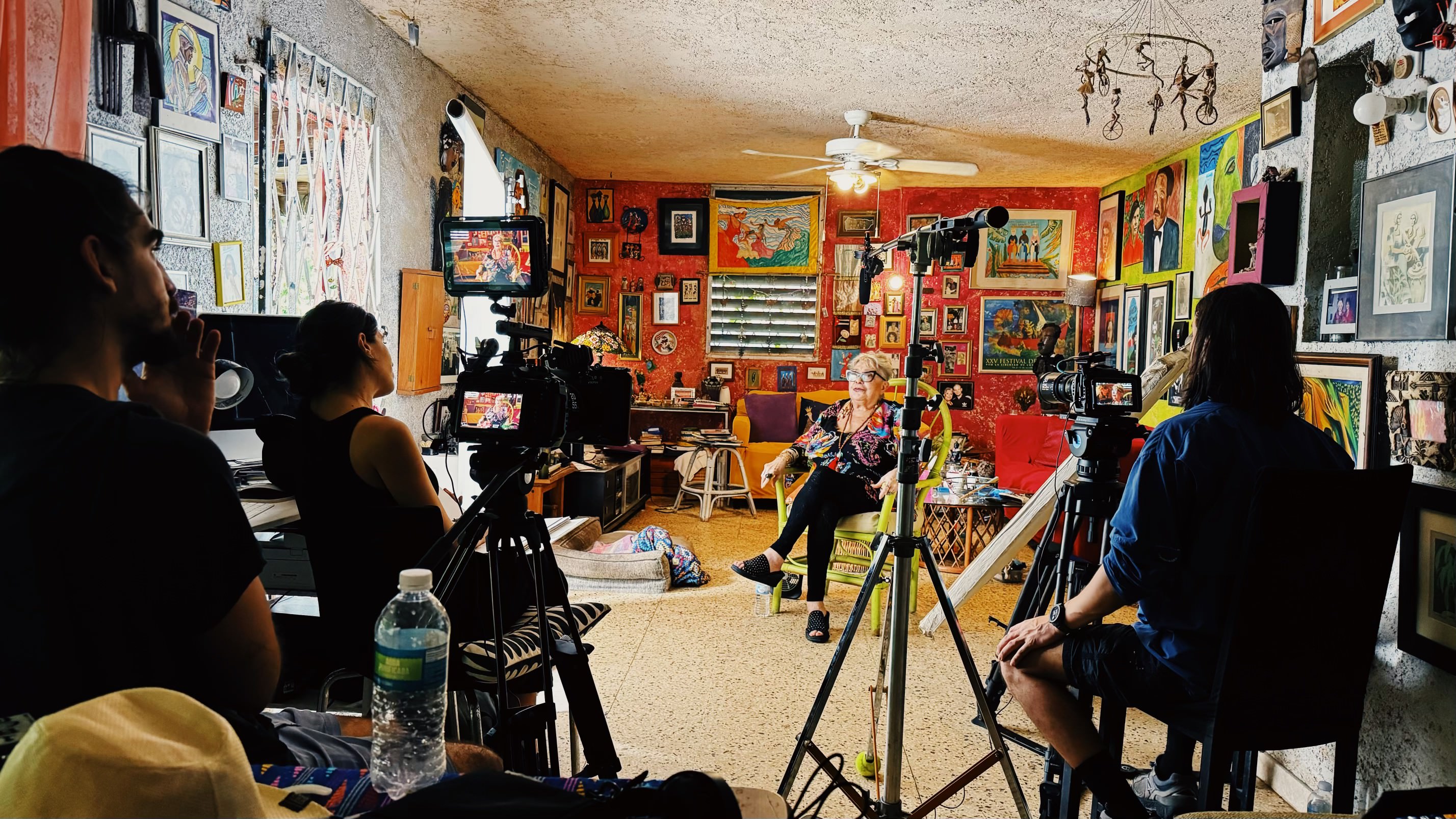
*Featured Image: Image of an interview with Dylcia Pagán as part of production for Barrio Television. Photo credit: Kristofer Ríos.

Maria “Nenet” Barrios is an Argentine-born and Philadelphia-based writer and music journalist. Specializing in storytelling that spans decades of Latin music, her work has been featured in publications including The Washington Post, Bandcamp Daily, and Grammy.com. Nenet is a 2025 cinéSPEAK Philly Cultural Critics Fellow.