This article is part of a column called Philly Profiles, which features in-depth profiles of local moving-image artists and cultural workers, including their body of work, inspirations, and upcoming projects. The column is written by cinéSPEAK Philly Cultural Critics Fellows.
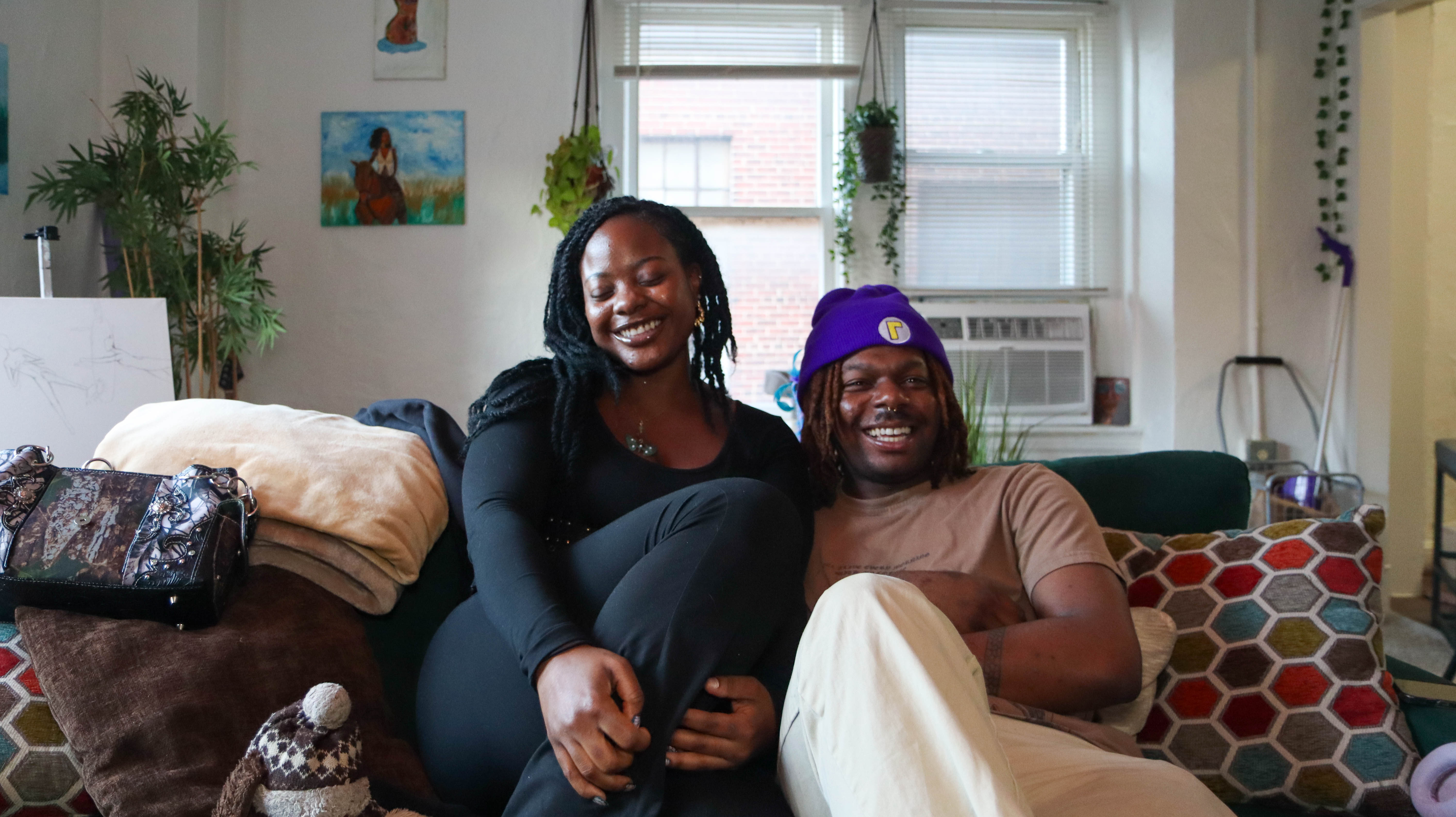
Darien Woodard and Taja Copeland, creators of the Philadelphia-based anthology short film series Queer Memoirs, stir fry sliced beef, rice noodles, and mixed vegetables inside the kitchen of Copeland’s well-loved apartment in downtown Baltimore. Winter-worn plants and abstract portraits, predominantly of Black femmes, spectate from the living room as the two filmmakers passionately cover “It’s All Over” from Bill Condon’s Dreamgirls film adaptation, singing all six characters’ parts complete with committed choreography.
Woodard is a queer writer, director, and producer native to Philadelphia. They’re the oldest of six, which undoubtedly contributes to their sharp sense of responsibility as a film producer; however, when comfortable, they exude the vibrant, carefree energy of a youngest child. Copeland, originally from Philly, is an award-winning queer writer, director, producer, actor, and youngest of three. Her composure and meticulousness, which is typically ascribed to an eldest, assures the structure and confidence necessary when directing. Don’t be fooled by the mutual pranks or deluge of jokes when these two share space—this uniquely balanced friendship is the secret ingredient in a cinematic recipe radically expanding the palate of Philly’s indie film scene.
“Queer Memoirs is a fun, easygoing series about queers all connected through this app called ‘Queer Memoirs,’ and they all kind of realize something about themselves, within themselves,” Copeland explains. “It’s a series for queers to just be instead of a series about, you know, the typical stories that we see of queers where it’s like ‘coming out.’”

Set in contemporary Philadelphia, each episode builds on the last with a distinct revolving cast of mostly Black queer characters. The series premiered at Morgan State University (Copeland’s alma mater) in 2025 as part of the Underground Studios Film Festival where it won the Judges Choice Award, and has been screened nationally at queer film festivals such as CinePride Film Festival in Los Angeles and Black Alphabet Film Festival in Chicago. The duo also hosted their own screening at Temple University, and plans to screen the entire anthology together this summer. All four episodes of the series are written, produced, and directed by either Woodard or Copeland and released under Woodard’s production company, Ten01Media. You can watch them all for free—which is radical for work of this quality—on Ten01Media’s YouTube channel.
Woodard stands by their distribution strategy, saying, “I think that nobody knows us enough yet to want to pay for our stuff.” Copeland adds, “We’re building our audience. We really want them to be able to access and view Queer Memoirs…because I think what we did was very important for the queer community in general.”
While Woodard began their filmmaking journey in 2016 at Wagner Middle School, they didn’t find much support until they joined POPPYN–a program for college students to support local youth in making their own media–at Temple. Upon leaving Temple’s program, they joined Big Picture Alliance (BPA), a filmmaking apprenticeship program for underserved Philly youth, where Woodard participated in their Media Futures and Film Futures programs. “I hated using the camera and editing. It wasn’t until BPA that I started liking camera operating and the editing process,” they explain. Today, Woodard is a BPA staff member and directs Big Picture Film Fest, the next installment of which is taking place on June 18th, 2026, and facilitates the Youth Set the Stage fellowship for filmmakers ages 15-24.

Copeland graduated from the Philadelphia Performing Arts String Theory Charter School. Originally she wanted to study acting, but a teacher encouraged her to pursue film production. “It meant a lot to me that he saw something in me,” she says. “It was something I was gravitating towards, but at that time acting was shining brighter than being behind the scenes. But I finally chose film production…It was just something that I became obsessed with.” Copeland majored in film at Morgan State University (much to the chagrin of her parents who urged her to become a nurse) and co-founded a student-led film organization named Underground Studios. It was during this time that she met Woodard at a mutual friend’s graduation party.
Woodard describes their collaborative history with Copeland, which spans six years and roughly ten projects, as their most “monogamous relationship.” Their first collaboration was their co-written short film six24, which Copeland also starred in. “I don’t think we’ve ever worked with a third party…Taj is really detail oriented, which works because I’m not detail oriented. I’m more bigger picture,” says Woodard.
Copeland chimes in, projecting over the tune of clanging pans and knives striking cutting boards: “We know each other. We know each other’s styles. We respect each other, and we are honest with each other. Darien would tell me straight up that they don’t like something or they don’t agree with something. And I’ll do the same.” Her latest film, Chasing Memories, which Woodard also assisted with, was selected to premiere at the Maryland Film Festival this April.
Watching Woodard and Copeland prepare dinner, it’s obvious this isn’t a case of too many cooks in the kitchen: the stern and clear deliberation of steps and responsibilities; mindful communication when approaching each other’s blind spots; playful chastisement when mistakes are made. These subtle habits hint toward a deep awareness of each other’s strengths, weaknesses, and capacities, and offer a glimpse into their process of working together in the tense environment of a film production.

Queer Memoirs, compared to their past collaborations, is a matured synthesis of Woodard and Copeland’s film aesthetics: character-driven establishing shots and musical intros; naturalistic dialogue revealing grounded friendship dynamics; delicately balanced comedy and drama; the careful examination of Gen Z’s pursuit of connection. The pacing, comedic timing, shot composition, and awareness of audience expectation improves more and more with each collaboration.
“I handle most of the producing,” Woodard reflects. “I just like logistics. Taj has great emotional intelligence and I think it reflects within the stories that she tells. [She] is the nicest on set. I feel like we run sets like how music artists treat their recording sessions. It’s a fun time; we’re coming to make art.”
Copeland adds, “Darien taught me to outline first, to plan a little bit more, which helps the process a lot. [On set], I’m thinking about the acting, making sure it feels natural. Since [Queer Memoirs] was budgeted, which we’re so grateful for…having a team relieved all the pressure.” This first volume of the series was supported by grants–a first for the filmmakers–from People’s Media Fund and Scribe Video Center.
While surely in the lineage of films like Barry Jenkins’s Moonlight and Cheryl Dunye’s The Watermelon Woman, it was media like Emma Seligman’s Bottoms and Awkward Virgo Production’s The Comic Shop series that inspired their latest project, which is flirting with virality online. Inspiration for Woodard and Copeland also flows from the likes of film and television creators Issa Rae, Gregg Araki, Terence Nance, F. Gary Gray, Ryan Coogler, and Zinzi Evans, as well as poets and musicians Nikki Giovanni, Tyler the Creator, Queen Latifah, and, of course, Beyoncé. “Taja is definitely the Beyoncé of the group,” Woodard admits. “I like to think I am, but I’m probably a little bit more Kelly…we don’t have a Michelle though, no shade.”

The ingenuity of Queer Memoirs lies in its capacity to center the proverbial achilles’ heels of its characters, and consequently, their humanity. Astrid’s insecurities, Lucki’s rigid sense of gender, Chilles’s controlling habits, and Remy’s conflict avoidance all humanize queerness. In prioritizing authentic depictions of queer folks, Woodard and Copeland are yelling the often hushed, more complex conversations—about queer artists “selling out,” rigid gender roles in queer relationships, and gay transphobia—with no regard for judgement or consequence.
“We don’t go in at all with the thought about what people outside of our audience [are] going to think,” says Copeland, preparing to break her Ramadan fast. “Our [work] is clearly for everyone but it’s definitely geared towards the queer community…[our focus] is more how our main audience will feel and if they will see themselves…everyday lives, everyday desires.”
With a spotlight on friendship, and a rebellious attitude towards respectability, Queer Memoirs is a vulnerable, awkward, and hilarious feast of innovation catered to a representation-starved audience. “We just don’t like to be censored,” says Woodard, who is also fasting and about to eat their first meal of the day. “All the stories we’re going to tell are going to be truly authentic.”
*Featured Image: Image of Taja Copeland and Darien Woodard. Photo credit: David A. Gaines.

David A. Gaines (he/they) is a poet, director, actor and educator born and based in Philadelphia. As an award-winning, nationally touring poetry performer and Poet Laureate of Pennsylvania’s Montgomery County, their work has been featured in several publications including The New York Times, Philadelphia Inquirer, VICE Media, and Button Poetry, among many others. Gaines is a 2026 cinéSPEAK Philly Cultural Critics Fellow.