Cinema’s biggest lie is repeated in the credits of almost every movie: “a film by ___” or, for more reputable directors, “a ___ film.” These seemingly innocuous directorial attributions are in fact claims of intellectual property which reinforce filmmaking’s strict hierarchy and obscure the inherently collaborative nature of production. Filmmaking isn’t typically a democratic venture; however, in the wake of Tarana Burke’s me too. movement and the ensuing surge in demand for intimacy coordinators, a growing number of people are reimagining a more equitable practice of filmmaking. Shavon Norris is one of the courageous artists leading the way.
Norris is a “Bronx-born, Philly-fed” artist, educator, facilitator, professor, and 2024 Pew Fellow. In addition to her role as an adjunct dance professor at Temple University, where she earned her MFA in dance, she also provides trauma-informed, healing-centric consulting work for a variety of organizations, including Philly-based ad agencies, theater companies, and art museums.
“During the pandemic, there were a lot of big feelings [and] I got hired a lot to lead educators at explorations of intentional inclusivity on things like how we decide what we value; where those values come from; how they affect us as humans [and] our classrooms; [and] what can we invite ourselves to consider to build nests for students, as opposed to walls and barriers,” Norris explains.
While not a filmmaker in the narrow and technical sense, Norris has shared her pedagogy in collaboration with BlackStar Projects for their Philadelphia Filmmaker Lab Fellowship. During the fellowship, guest artists were invited to host workshops on various aspects of filmmaking, such as cinematography, editing, and production design. But when Norris visited the fellows, she asked them to write down their recipes for making rice—a practice that changes based on one’s ethnicity, location, time, and history—which was really an invitation to consider their origins, values, and biases so that they can create film sets that are thoughtful of other people’s backgrounds, values, and individualities.

“It’s like a decentering and deprioritizing practice…How do I constantly invite myself to decenter myself? Doesn’t mean I’m not important. It just means that my vision of the world or my experience is not the only one that’s out there…I pay really clear attention to language. So for example, I use [the word] ‘invitation.’ Inviting people to explore with me, or to move with me, or to be curious about a thing, has more options than ‘what I need us to do,’ or ‘what I want us to do,’ because then it’s aligned with how you feel about me,” Norris explains.
Her first time on a film set was performing West African dance during the production of The Last Airbender (2010) directed by M. Night Shyamalan. Her scenes were removed from the final cut but the experience left a lasting impact. “I remember one of the times [on set] we were all dancing around and Aang frees us,” Norris retells. Aang is the film’s protagonist, and the Black people in the scene are imprisoned by a colonial empire. “[Aang] was white [with a] bald head and these are dreadlocked people who committed their lives to drumming and doing West African dance…we all looked around and agreed this was problematic.” On another kind of set, perhaps one that empowered its creative laborers, these kinds of microaggressions and instances of harm could be fielded, reduced, or eliminated.
The foundation of Norris’s healing-centric praxis was concretized over an 11-year career teaching kindergarten through fifth grade at Independence Charter School. “I became really aware [that] whatever I was experiencing would affect the classroom,” she reflects. “If I raise my voice, that impacts the room. If I’m cranky, my crankiness is so fucking contagious. It took me a couple of years to realize, like, bitch, it’s not them, it’s you. And so I developed a culture of deep awareness with my students about our internal lives.” The school hosted workshops with facilitators from Lakeside, one of the nation’s leading providers of trauma-responsive clinical and educational services, who gave Norris the language for the work she had been developing with her students. She says that this healing work “found her.”

Norris is a free spirit who clearly hasn’t lost the childlike curiosity, playfulness, and eccentricity that many artists fight dearly to protect. In conversation, she genders objects and ungenders people; uses her name as a verb (Shavonned (v): to personalize and improve); and delivers sentences with a careful cadence dappled with brief pauses as if searching for the most accurate and least violent language. Her living space is as unique and intentionally curated as her artist practice. You might be deceived by the unassuming exterior of her recently purchased South Philly home, lovingly named “Taskie,” but inside is a sparkly yellow portal transporting guests into a new dimension. The entryway is lined with celestial photos of her most pertinent influences—Octavia Butler, Nichelle Nichols, Henrietta Lacks, Harriet Tubman, among others—with the most influential of all being her mother, who continues to be an integral part of her life and creative process. Norris, in her own words, wasn’t an easy child to raise.
“The building blocks of my trauma-informed practice happened before somebody told me this is trauma-informed practice,” Norris says. “I was a very expressive, maybe even explosive child. My mom was definitely annoyed…but I never felt all of the language around [being] ‘too sensitive’ or ‘too much’ from her.” Providing an example of her childhood sensitivities, she says, “I hated milk. [It] made my stomach hurt, and this is before we were like, ‘people are lactose intolerant’ or whatever…Every morning, we would eat cereal…I was under duress, like I didn’t have a choice, so I used to flush it down the toilet [and toss it] out the back kitchen window.” What made her “difficult” as a child was the seed of a lifelong commitment to honoring and listening to her body; a quality at odds with the exploitative film industry status quo.
For Norris, wielding power responsibly starts with acknowledging where power lies in the room. Her work generally starts with a welcome, first to the audience, then to whatever energy she wants in the space. Beginning in this way disarms, engages, and fosters connection. While she doesn’t make her own films, she utilizes the same care-centered framework that she offers filmmakers when creating her performance art pieces.

“I’m working on a piece for November called The Croning,” Norris says. The Croning is an ensemble movement and theater piece written, performed, and choreographed by Norris that centers Black women’s experience with aging. She debuted this latest piece, scored by cellist Mel Hsu, as a solo performance in the 2023 Bearded Ladies Late Nite Snacks for the Fringe Festival and received a Philadelphia Cultural Treasures project grant to adapt the show into a larger performance this fall. “I’m in the process of thinking about who are the designers, the production team [for the show], and I’m more curious about how people talk to other people than about their skill set.”
Prioritizing the crew’s wellness during production isn’t easy; in Norris’s case, it has meant reducing the amount and duration of tech rehearsals to accommodate her ensemble cast which includes five elders—among them is Philly’s own Bethlehem Roberson, Lisa Nelson Haynes (the former director of Philadelphia Young Playwrights), and legendary lawyer, dancer, and choreographer Germaine Ingram, who is Norris’s mentor and the first Black woman hired full time at Temple University School of Law. “I want to center the cast,” Norris says. “I don’t want to do what’s efficient…I want a refined product [but] it’s helpful for me to remember that the ‘definitions of success’ haven’t included me in their development. [So] it might be more healing-centered to come up with the terms and conditions that are relevant and specific to me.”
The Croning will be scored by a chorus, featuring Philly-based vocalist Elle.Morris, and produced by Journey Arts at Christ Church Neighborhood House for the first two weekends in November. Ahead of The Croning, Norris, in collaboration with ArtPhilly, was scheduled to exhibit a thematically related show at The Painted Bride Art Center this June titled The Becoming; however, the decision was made to postpone the show due to health concerns within the cast.

Inside Norris’s living room, African sculptures rest on wood shelves and origami cranes flock on strings like marionettes; a sweet aroma precedes an altar attended by incense, melted candles, and tarot cards; her journal pages and favorite framed quotes form a gallery on the walls leading upstairs. Her practice of clearly communicating boundaries with gentle invitations of agency are summed up by the bucket of cloth slippers at her front door (as part of a strict “no shoes indoors” policy communicated to guests pre-arrival). “I like to supply options,” she offers. “Options, for me, lead to liberation. If I only have yellow, I can paint a million things, and it might be beautiful, but if I have the full landscape of the colors and I choose yellow, there’s something different in that.”
A more communal approach to film production wouldn’t diminish the necessity of the director. We need leadership to complete shared goals and authorship is an important building block for organization, accreditation, and accountability. However, the number of brains and bodies involved in bringing even the smallest film to life multiplies the opportunity for exploitation and necessitates the efforts of artists and cultural workers like Norris to reduce harm and empower the invisibilized.
“I would like to have all of the awards and acclaim,” Norris says. “But if my people that have worked with me can’t speak to the experience in a loving way, if their humanity felt harmed in the process, but my product is beautiful, I don’t know about that. I’m not attracted to that. What does it mean for us all to be in our power and not dominate other people?”
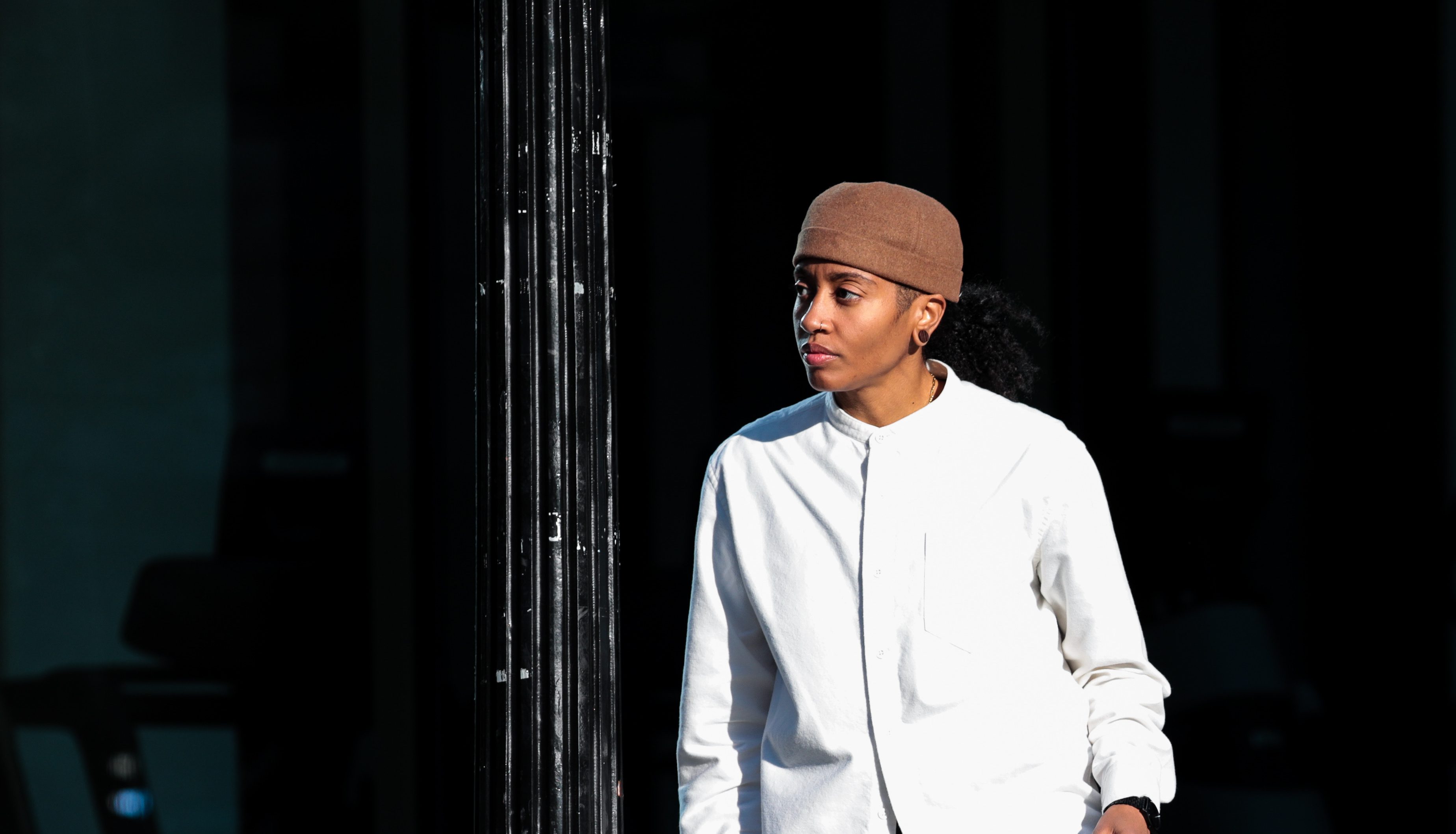
*Featured Image: Image of Shavon Norris outside her home. Photo credit: David A. Gaines.

David A. Gaines (he/they) is a poet, director, actor and educator born and based in Philadelphia. As an award-winning, nationally touring poetry performer and Poet Laureate of Pennsylvania’s Montgomery County, their work has been featured in several publications including The New York Times, Philadelphia Inquirer, VICE Media, and Button Poetry, among many others. Gaines is a 2026 cinéSPEAK Philly Cultural Critics Fellow.