
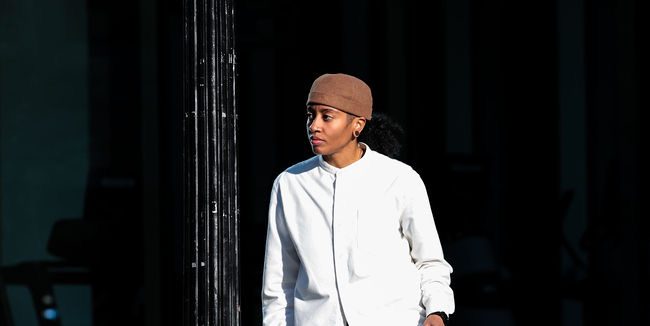
The film industry can feel like an elite nightclub with tight security that doesn’t make exceptions for economic realities like inflation or funding cuts to the National Endowment for the Arts. If you want the gatekeepers’ acceptance, you’re strongly encouraged to adhere to a strict dress code and conduct; respect and obey authority; follow industry trends and traditions; and appeal to as large of an audience as possible. But what happens when the “club rejects” reject the club? The unorthodox trajectory of Elizah Turner, a rising creative producer in Philly’s indie film scene, is a perfect example of how despite the film industry itself being exclusive and costly, the praxis of filmmaking has many points of entry wherein every skill and life experience can be useful.
Turner is a proud Texas native and the biggest Janet Jackson stan alive—seriously, ask her about it—who has lived in Philly for the past six years. “[My] dream started back in high school. My number one goal was to be the editor-in-chief of Vibe magazine,” Turner reflects. “I was editor-in-chief of my newspaper in high school, and I think that was the start of my creative journey. I didn’t identify as a creative for a very long time; that evolution came from being exposed to different people, specifically Black women in my path, that I’ve been friends with or have as mentors. I wouldn’t have called myself [a creative producer] maybe six or seven years ago.”

Despite not identifying as an artist, the horizon of her creative identity expanded after a school trip in 2008 to Ghana to study ethnomusicology as a part of a journalism degree from the world renowned jazz school University of North Texas. In West Africa she was immersed in research of the Ewe people and witnessed their artistic practices in religion and ritual. After returning to America, she got her hands on a Canon Rebel XTi which accelerated her love for visual arts and disillusionment with journalism due to its heavy restrictions on authorial voice and subject choice. Turner was pushed towards digital media by professors who foresaw print’s decline in relevance and decided to switch her major to Film/TV, but she couldn’t afford the additional two years it would take so she graduated with a Bachelor’s in journalism. This missed opportunity only hardened her resolve and she quickly packed up her life for Atlanta in pursuit of an artistic calling.
“Atlanta was the first place that I ever saw Black people doing well who were young. My first time visiting there, I was just blown away,” Turner mentions. In Georgia, she serendipitously became involved with rising star Janelle Monáe’s first national tour in 2013. “I started with [Janelle Monáe] in 2010 as an intern. I was one of 36. I did little things with her for her album ‘The ArchAndroid’ she was releasing at the time. Fast forward a few years, she put out ‘The Electric Lady’ [and] went on her own tour…I was the only one from that intern class that got hired to work on the tour [as] the merchandiser…What I learned specifically from [Monáe’s collective] as a whole is that it’s very important to have a vision for what you’re trying to do.” Turner also supported Stacey Abram’s 2018 campaign for governor and drew from her touring background to design their Stussy-inspired crew shirts and craft immersive voter experiences.

The first film that listed Turner on its call sheet (as a unit still photographer) was 2013’s Sweet, Sweet Country, written and directed by Dehanza Rogers and starring Danielle Deadwyler and Gbenga Akinnagbe. “I was only on a handful of film sets before I produced my first project,” she says. Turner made her debut as a creative producer in 2021 for the short film The Funnel, written and directed by Charlene Carruthers. “This was the first project where I took everything that I had learned from being on film sets and applied it. Film production greatly mirrors tour management in many ways…both require the ability to move people around on tight timelines and respond quickly to any hiccups in the plan.” Turner’s zeal for art and community would soon prompt a difficult but transformative migration to Philadelphia.
“I had a crush on Philly,” she says. “There are so many things that’ve shaped the city that unless you’re from here or you have people who’re from here you may not know about. We know great musicians come from Philadelphia because we’ve had the ability to experience their work. But if you don’t know the history of the city, you don’t know the institutions that were put into place that allowed for those young kids to have that foundation, such as CAPA and the Clef Club. A lot of what I’m being shaped by are the told and untold stories here.”

Turner has worked below the line on sets for Netflix and HBO and is currently producing her directorial debut: a short film series called Black Gold. In her words, the project “reimagines the stories of largely unknown Black artists and musicians as they navigate the complex world of the music business while staying true to their morals.” She plans to bring this series to life in collaboration with diverse partners including a music historian, archival producers, costumers, and a production designer. Philly, while greatly represented in American media, isn’t considered a hub for film and television production (that distinction belongs to Los Angeles, Atlanta, and New York). However, industries aren’t static spaces and resilient artists like Turner adapt to the ever-shifting tectonic plates of their landscapes.
“Hollywood is drying up and it’s shifting over to the East Coast in a way,” Turner remarks. “From a bigger standpoint, I can see how that’s happening because I came from Atlanta. Atlanta had a good 10 years of producing a shit ton of projects because they had this amazing tax credit that was like a generous refund for productions that shot over [a certain amount] of dollars.” It didn’t take long after her arrival in Philly for Turner to make an impact. In 2022, she was selected as a producing fellow for the highly competitive BlackStar Philadelphia Filmmaker Lab, where she produced the short film The Freedom to Fall Apart—a brilliant comedy that the author of this article wrote and directed and shamelessly plugs—which premiered at the festival the following year and is currently available to watch on Xfinity’s Stream and Xumo Play services.
Turner also started organizing events in between films alongside her production partner simóne banks. “I love producing films [but] it’s not as instantly gratifying as certain other aspects of art,” she says. “If you [paint], you could have a result in a few days. [In film] it’s not the same type of process.” Sapphyre, Turner’s event series produced with a stellar team of women, is a “queer social mecca” that prioritizes accessibility while staying true to its target audience. “Sapphyre is my reverse engineering of community building. I came to a place where I didn’t know people. I suffered through a pandemic here without a great amount of community. I went through a breakup, and I wanted to create a space that felt good for me, and I knew that I could attract the people who wanted those same things, and I did.” Sapphyre was founded in 2025 and draws large throngs of predominantly Black queer women with its saturated blue tones; rotating lineup of clairvoyant guest DJs; and a chic, electric, erotic atmosphere that feels like stepping into the iconic Ernie Barnes’ The Sugar Shack painting (but way gayer).

Turner lives by her own definition of a producer: “I think overall a good producer is someone who can remove any obstacles that may get in the way of the director’s vision for the project. I’m a great creative producer because I have a background of being a photographer, videographer, graphic designer, tour manager, [and] merchandiser. I’m not a person who’ll only draw inside the lines of what it takes to complete a project…I’ll rewrite scripts, cut trailers, source music, design websites, create the key art and marketing materials. [You don’t need to hire] outside people to do those things because those skills all come from my wheelhouse.”
Producers are indispensable in the filmmaking process and often wear many hats; however, they rarely receive the attention, respect, and credit that they deserve. Perhaps we’ll see less of this unfair pattern as more producers take on front-facing creative roles. The multi-hyphenate filmmaker phenomenon is as old as film itself, but in our late stage capitalist celebrity-obsessed culture, where an artist’s brand eclipses their art and so-called nepo babies and industry plants are thriving, this trend has escalated to its zenith. Many emerging filmmakers are incentivized to select their roles not based on interest and skill but what’s most lucrative or will give them a leg up in an unforgiving industry. Turner, however, refuses that logic and centers her passion.
“I would say to [any emerging creative] to entertain all of the things that inspire you, because you never know what you’re going to end up coming back to,” she advises. “[Also] you should fail in public, like in ways that people are afraid to admit. Utilize your vulnerability as a strength.”
*Featured Image: Image of Elizah Turner. Photo credit: Samira Rashid.

David A. Gaines (he/they) is a poet, director, actor and educator born and based in Philadelphia. As an award-winning, nationally touring poetry performer and Poet Laureate of Pennsylvania’s Montgomery County, their work has been featured in several publications including The New York Times, Philadelphia Inquirer, VICE Media, and Button Poetry, among many others. Gaines is a 2026 cinéSPEAK Philly Cultural Critics Fellow.

