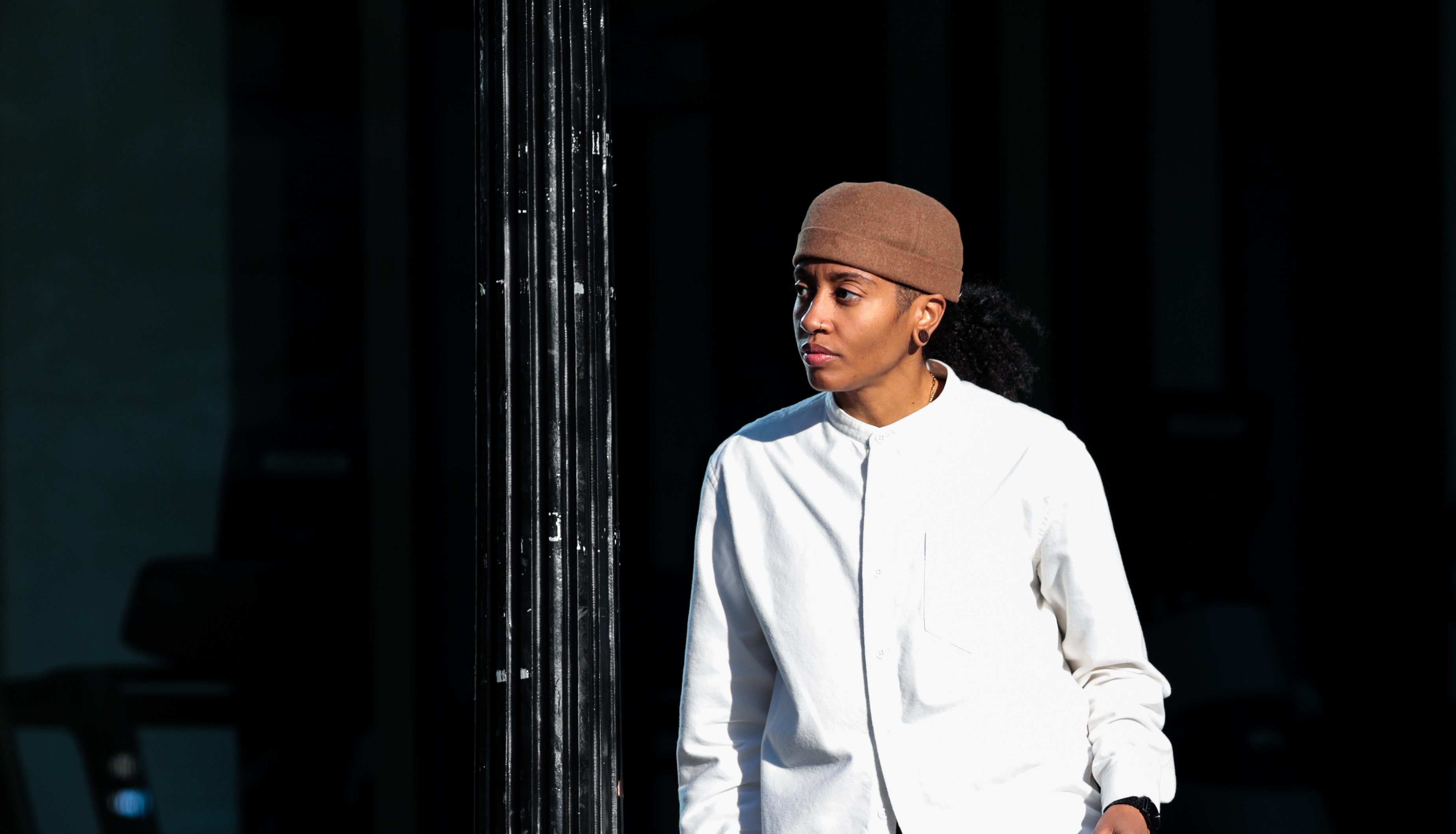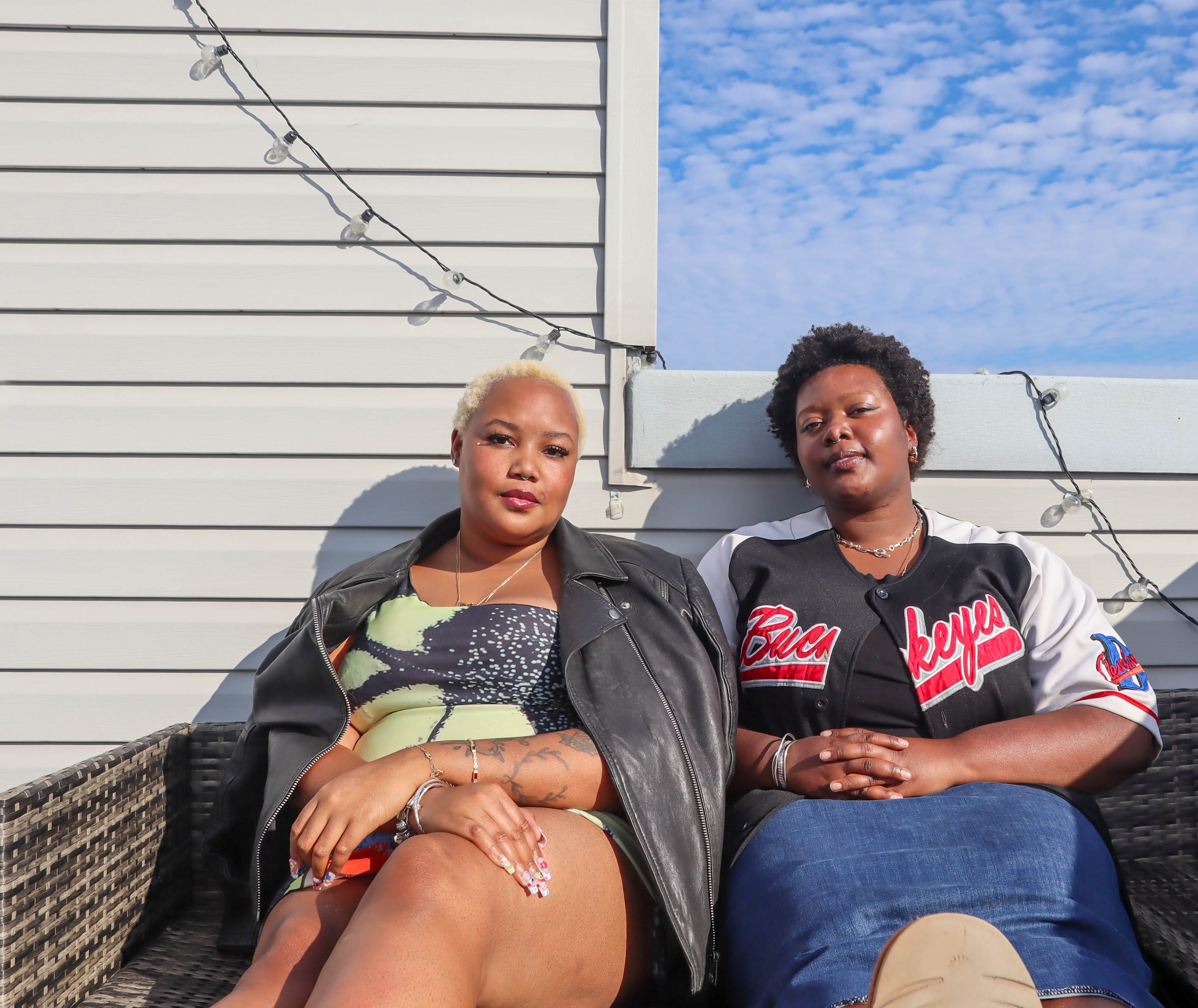
Cringe culture—an internet phenomenon where the behaviors that our social contracts sanction as awkward and uncool are publicly shamed—may unironically be the most insidious threat to today’s rising generation of chronically online filmmakers. Punishing public displays of effort and sincerity disincentivizes people from taking risks needed to learn new skills, pursue curiosity, and express themselves authentically. This humiliation ritual is a black hole that pulls artistic communities towards self-policing and performative publishing. Liberation from this restrictive culture, as exemplified by Philadelphia’s premier sibling filmmaking duo Rachael and Bekkah Moton, requires an unabashed, unyielding, and, at times, unhinged, sense of humor and play.
The Motons were born in Philly and are currently based here. Rachael is a writer, director, educator, and Temple Film School graduate with a wide range of illustrious credits including promotions for Megan Thee Stallion’s Good News album rollout; selection as a finalist pitching at the ABC Women’s Production Initiative; and acceptance into the Sundance Ignite Fellowship (one of the most competitive film fellowships in the world). Bekkah is a writer and creative producer who, while seven years younger and less prolific than her sibling, obtained a film degree from the renowned NYU Tisch School of the Arts and is the oxidant combusting their comedic rocket.
“You know she had to surpass me because I only went to Temple. She had to show off,” jests Rachael, who chose her college based on its proximity to their family.

“I think the education is better [at Tisch] for sure,” Bekkah claims. “Also I feel like…[at] any art school you have to deal with imposter syndrome. [Some] people just get things a little bit more easily. It’s definitely good as far as getting the information and knowledge you need, but it can be a lot of background noise that you have to filter out.” Scrutiny and unsolicited opinions are like an asteroid belt that every emerging artist will have to navigate, and the Motons learned to maneuver these occupational hazards during their upbringing as closely watched pastor’s kids.
“I was so scared to post stuff online because I [felt] like somebody at my parents’ church was gonna call my dad, and they did,” recalls Rachael. “But as an artist, I have this responsibility to be visible because what I’m saying matters and helps other people.” Their father tried to recruit them into his ministry, but they found their own route to spirituality. “I feel like God be speaking to me, but just in a different way. There is nothing more intensely religious to me than building community with people you don’t know with a common goal of creating something…There’s something really holy about the space we create with Moton Universe and Nepo Baby Film Club. [We’re] building off of the things that our parents taught us.”
Nepo Baby Film Club is “a filmmaking community for the people who don’t have a famous last name.” Members of this free Patreon get access to grant, fellowship, and opportunity roundups, as well as meet-ups, events, retreats, and workshops—including an upcoming webinar in collaboration with Tribeca Film Festival where folks can learn how to pitch for the festival’s Untold Stories competition—with even more features available in higher cost tiers. Moton Universe is the station that houses Nepo Baby Film Club and this sisterhood’s other creative enterprises.

“I think Moton Universe was really just born out of me and Bekkah being tired of not making anything,” says Rachael. “We’re trying to build a community that’s based on being honest and vulnerable [about how] the industry is not what we were promised in film school. Independent cinema isn’t dying, it’s just harder for people like us to get funding than ever. How can we take our resources and share them?” This is the opposite of a sibling rivalry; when these two aren’t organizing, they’re collaborating and creating new worlds through earnest artistic expression.
Witnessing Rachael and Bekkah goof and riff—finishing each other’s sentences, sharing fresh memes, discussing their latest obsessions (aliens, conspiracy theories, and Tinashe)—it’s evident that there exists a rare comedic synergy exclusively reserved for siblings who find themselves pursuing similar creative fields. “When I get my money up, I’m donating to the Monterey Bay Aquarium because they have [animal live streams] going 24 hours a day,” declares Rachael. She turns the television to a small bloom of jellyfish gliding through crisp blue water as if floating through the cosmos. “Sometimes our writing process will just be us putting [one] on, and then sitting in a room with our laptops and [asking], ‘What have we seen recently that inspired us?’ If we see too many memes that touch on the same things we’ve been talking about, that’s something we need to write about.”
Rachael and Bekkah are both working on their debut feature films, Paper Trail and Twenty Eight, respectively. A proof of concept, short version of Twenty Eight is currently in post production. “[My feature is an expansion] of my senior thesis from school,” offers Bekkah. “It was a love letter to our aunt that passed, and it’s still in an incubator mode because it’s been so hard wrapping around grief lately…love really does get people through, [and] that’s kind of what Twenty Eight is [about].” Bekkah is also developing a comedy variety show, appropriately named The Moron Show, and directs a podcast called Everybody Loves Rachael wherein her sister interviews compelling guests (the first of which was her ex-boyfriend about their relationship).

Rachael shares that “Paper Trail is a dark comedy about the dangers of performative activism online and social media, but [it’s] also a story about siblings and family and the influence of religion.” Her previous two narrative shorts, Dad’s Dead Damnit and Mary Mary Quite Contrary, are also dark comedies despite her fear of horror films; the latter, in particular, showcases her subversive comedic aesthetic. Set in 2032, this satirical narrative short film directed and co-written by Rachael and the film’s star Mackenzie Breeden centers an invasion of aliens who demand to abduct a female virgin, and the subsequent US mandate for women (age 25 or older) to undergo medical testing to determine if they are sexually eligible. Mary, the protagonist, frantically seeks her first sexual experience to dodge this “virgin draft,” so to speak.
There is a delicate science to balancing the gags and gravity of a premise like this—in one scene, women line up in a hospital to receive their exam date with the casualness of getting a ticket from the deli aisle as one woman is detained by an officer despite her protests. In a brief montage, Mary begrudgingly goes on a number of embarrassing Tinder dates to get laid in an attempt to save her life. And in a dream sequence, animated like a children’s shadow puppet show, she passionately confronts the aliens about gender-based violence, women’s diminishing bodily autonomy, and rape culture. Rachael has developed a unique formula for using comedy as a vehicle to trojan horse urgent and radical perspectives into her work.
“When I was in film school, I didn’t really pay attention a lot,” Rachael admits. “I wasn’t a good writer because I was trying to write really serious things and I’m not a serious person. I had professors literally tell me that I needed to give up and pursue something different because I didn’t have good ideas…[Later on I realized] I’m good at this, I’m just not good at what you guys want me to be good at [and] so I need to find my own path [using comedy as a tool]. If I can make somebody laugh, I can calm them down and disarm them to listen to what I have to say.”

All comedy films are pass or fail—either the audience is laughing or they aren’t. Laughter is a primal, uncontrollable urge that relieves tension within the body and has been proven to strengthen relationships and boost mental health. While there is no scientific consensus on why we laugh, and some speculate that humor is something you’re born with and can’t be taught, there are many rules, principles, and faculties involved in making a room full of people roar in hysteria. Comedy in film demands an awareness of timing—of a joke’s delivery, the time period, or distance from a tragedy—as well as consistent wit through the all stages of production (i.e. writing, performance, and editing) for maximum effectiveness. The Motons carry on the tradition for comedy to speak truth to power, which requires freedom, introspection, and candor that has historically made comedians a threat to fascist governments and targets of hateful suppression.
“I got my first hate comment on TikTok,” says Rachael with a triumphant grin. “This lady was like, ‘Oh, I hate you bitches from Filth-adelphia’…I felt so good. I want to print it out and frame it. I literally responded to her and [said], ‘Thank you so much because I didn’t think that I was that poppin, but now that I have my first TikTok hater, the sky’s the limit’…People have told me that they think [my social media presence] is honest and that’s why they are interested in it. And I think, at least for us, we can see transparently when people aren’t being themselves on social media and only showing the highlights. That’s why I try to be really open with the audience that I have about, like, I just got rejected from a grant last week. We’re all trying to figure things out.”
“Life is just really absurd and cringe in [itself],” says Bekkah as she laughs through the pain of a recently broken ankle. Rachael chimes in: “There’s something cringey about being vulnerable and existing…I’m not afraid of cringe culture. I will be insane online. I don’t care anymore…It’s more cringey to be a hater than to just be yourself and have fun because where else do we have spaces to share media and connect with people? There’s a lot of fear in having to be open as an artist. But it’s less scary when you know yourself and are sincere about it and genuine.”
*Featured Image: Image of Rachael and Bekkah Moton. Photo credit: David A. Gaines.

David A. Gaines (he/they) is a poet, director, actor and educator born and based in Philadelphia. As an award-winning, nationally touring poetry performer and Poet Laureate of Pennsylvania’s Montgomery County, their work has been featured in several publications including The New York Times, Philadelphia Inquirer, VICE Media, and Button Poetry, among many others. Gaines is a 2026 cinéSPEAK Philly Cultural Critics Fellow.