This article is part of a column called Philly Profiles, which features in-depth profiles of local moving-image artists and cultural workers, including their body of work, inspirations, and upcoming projects. The column is written by cinéSPEAK Philly Cultural Critics Fellows.
“Oh, this needs to be documented…it needs to be remembered, and people need to see themselves,” Aidan Un says about Philadelphia’s vibrant hip hop dance scene.
You Don’t Have To Go Home But… archives the Silk City era of Philadelphia’s Second Sundae monthly dance parties where iconic DJs and dancers gather to participate in freestyle battles for a cash prize. Although for many dancers, the parties are much more than a competition. The feature-length documentary, directed and edited by Un, captures this particular pocket of Philly dance. The film intimately follows three local dancers–Bryant “Diddy” Lee, Jazmin “Jenesis” Gilbert, and Christian “Mach Phive” Walker–who share their backstories and what keeps them coming back to the cipher.
Un decided to pursue filmmaking when he was a senior Philosophy major getting ready to graduate from Haverford College. Originally from Boston, Un’s family moved to France when he was one, where he lived until moving to Philly in 2007. He recalls the time when filmmaker Eli Jacobs Fantauzzi screened a film at his school, which demonstrated the possibility and lifestyle that filmmaking could offer.
“[Fantauzzi] was traveling the world, making different films about hip hop, seeing different scenes around the world. So he had gone to Cuba, he’d gone to Ghana. He was just traveling the world and making these documentaries, and he came and screened a film at our school…So that was like a light went off for me.” Un then had a full-circle moment when Fantauzzi attended the 2024 premiere of You Don’t Have To Go Home But… at BlackStar Film Festival. The film won the audience award for Favorite Feature Documentary.

At Haverford, Un got the chance to make a short film as an assignment. It opened the gateway to his passion for seeing the world through the camera lens. “It was like as soon as I turned the camera on and I saw the image through the LCD screen, I felt my whole orientation of space and time change…seeing the world through that little rectangle and being able to carve little frames of it out. And feel like, ‘Okay, who do I want to talk to and what do I want to ask them?’ [It] just made me feel so intensely present, in a way that made me feel really alive.”
Un’s interest in documenting the story of Second Sundae at Silk City began when he was asked to take photos at one of the parties. Before the event, he was taking photos at a Silverback Open Championship–a sponsorship-funded international breaking competition that awards prizes of several thousand dollars to winners.
“I’ll never forget this, because we were coming back [from] a Silverback open…so first we went out there…you know, [an event with] super media ties, all the sponsors and people going crazy, arena style…People were doing these incredible things with their bodies…but then we drove with a car full of us to Silk City and we walked into the club…I just remember the way the lights looked, and I remember seeing the mirrors and…the glass that separates the DJ from the dance floor, and seeing reflections of the dancers in there…People would just get down in a way that was equally awesome.”

He reflects on the ways Mark “Metal” Wong and Steve “Believe” Lunger helped birth the idea of making the movie. “Metal, Steve, and I…were like, ‘Let’s turn this footage into a film.’” Lunger is the producer, and Un references Wong as a “dream partner” during the initial brainstorming and development phase for the film. Both Wong and Lunger are Philly-based b-boys and co-founders of Hip Hop Fundamentals. Un began filming Sundae parties in 2015. In 2020 the parties were paused in response to COVID-19, and the film began to take form during that hiatus.
Un took an immersive approach to documentation and cinematography. You Don’t Have To Go Home But… is captured almost entirely with his handheld camera, which requires him to become a part of the cipher–nearly a part of the dance battle in some ways. That same invested and intimate style of storytelling can similarly be witnessed in his conversations with Diddy, Jenesis, and Mach Phive. Viewers are given glimpses of the dancers’ day-to-day lives, as they chat with Un about their incentives to dance and what sets the Second Sundae ciphers apart.
“I had these images of them being so expressive. I was like, ‘Where is this coming from? What is making you move your body in this way? What is animating you?’ I wanted to understand what people were doing when they weren’t at the club, when they weren’t necessarily going home, but they weren’t dancing…And what was feeding that energy and that drive and that passion to dance.”

Un accompanies the dancers on their everyday activities like going to work, watering plants, working out, running errands, and chatting with family, in order to convey their stories with authenticity and accuracy.
“I wanted [to highlight] people who were at different stages of their lives and specifically their dancing lives…that you know a person with a passion, who lives in capitalism, or who exists in capitalism can move through.”
The dancers speak about their dance backgrounds, aspirations, and frustrations with making a livelihood from a career in the arts. These more personal scenes juxtapose the nightclub montages where high-energy images of the dancers engulfed in spectacular freestyle moments and mid-battle movement conversations are spotlighted. The intimate peek into their personal lives grounds viewers in the relatable truths and challenges of their individual journeys.
When he’s not making films, Un engages in a few movement and percussion practices of his own. He practices Capoeira Angola, and is a member of the traditional Korean percussion ensemble URIOL 우리얼. He’s also a long-time collaborator and videographer with Vince Johnson, a Philly-based dancer, martial artist, and founding director of Urban Movement Arts in center city. Un’s work with Johnson has encouraged him to think about filmmaking from a more intentionally embodied perspective. Johnson once invited Un to join him on stage as the videographer, prompting him to heighten his attention to his movements that facilitate the process of capturing an image on camera.

“It was really amazing to me, because it was the first time that my little dances as a filmmaker [weren’t] meant to be hidden and I wasn’t trying to stay out of the way.” Un takes a moment to appreciate the opportunity that allowed him to bring more awareness to his body while shooting film. “It really is a dance…the amount of body control that you have to exert, and the responsiveness to a source. But [Vince] invited me to do that on stage with him…I would just be filming him, but overexaggerating how I would normally film, so really leaning into the movements… not really caring that much about the image, and more thinking about the movements that I would feel moved to do at any point…and trying to accentuate them and express them. And that was so much fun for me. It felt like a release.”
Un admits that dance isn’t always a medium that fully resonates for him as a viewer, but watching dancers at the Second Sundae parties was different. “Dance is a learned language for me. And I was beginning to really understand what it meant in capoeira, but I feel like maybe [the Second Sundae party] was one of the first times I was like, ‘Oh, I feel what you’re trying to tell me.’ Maybe that’s also the way that Philly people would dance. They’re gonna make sure they’re understood.”
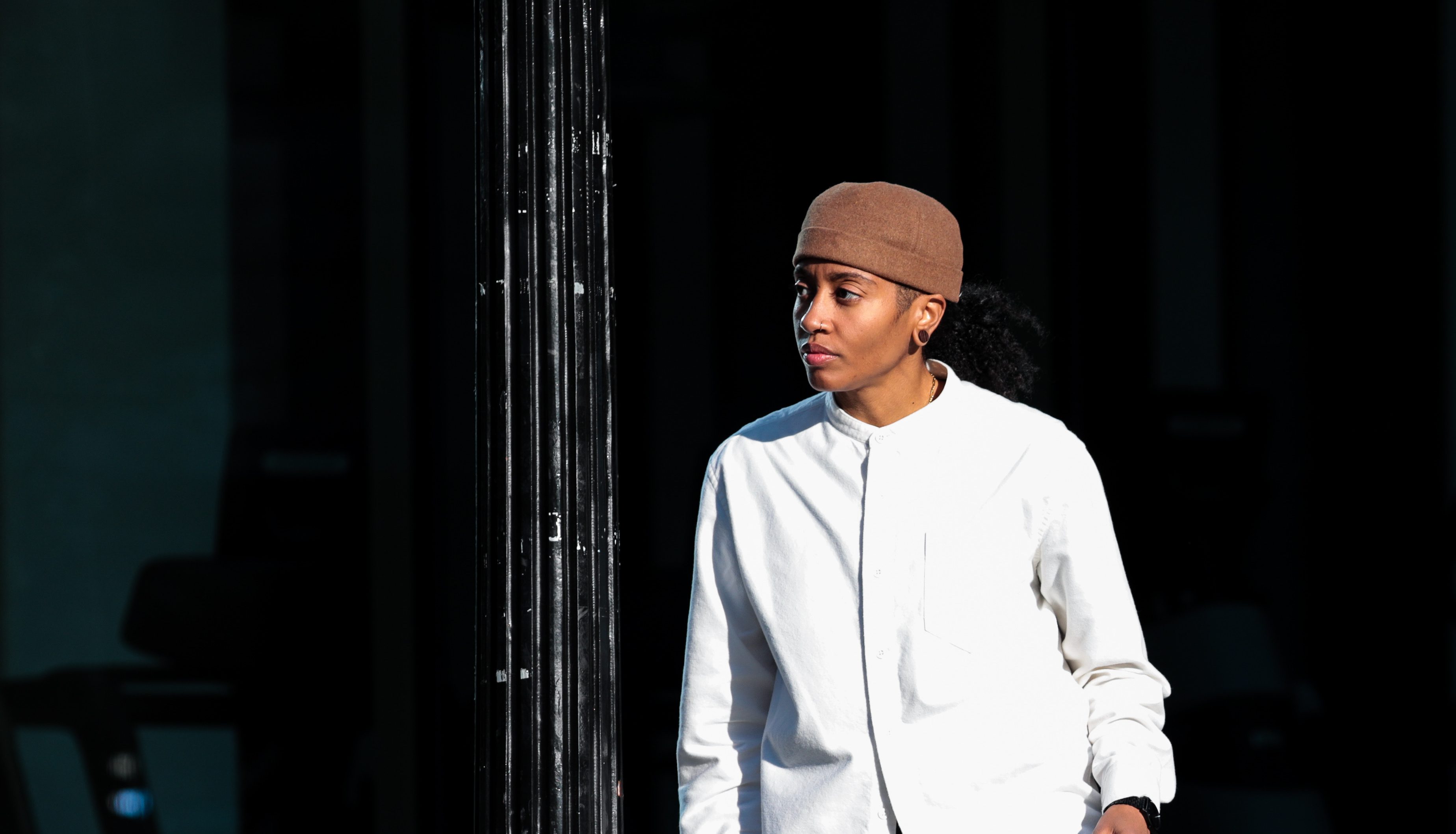
*Featured Image: Image of Aidan Un. Photo credit: Holden Blanco.

Caitlin Green is a Philly-based dance artist whose practice centers the body’s role in holistic wellness, catharsis, and socioemotional regulation. In addition to their work in choreography, performance, and education, they are a writer for the local dance publication thINKingDANCE and first-time director for the experimental dance film Eros: Fragile as it is Free. Caitlin is a 2025 cinéSPEAK Philly Cultural Critics Fellow.