This article is part of a column called Philly Profiles, which features in-depth profiles of local moving-image artists and cultural workers, including their body of work, inspirations, and upcoming projects. The column is written by cinéSPEAK Philly Cultural Critics Fellows.
Folklorist and filmmaker Selina Morales spent much of her childhood in her grandmother’s botánica in the South Bronx. Her grandmother, an espiritista, medium, and healer, describes the botánica as a “pharmacy for the soul.” Common in Afro-Caribbean and Latin American cultures, the botánica was a family-anchored space where Morales watched her grandmother heal the community. She describes her as nimbly juggling different roles: community doctor, social worker, and tradition bearer, connecting people back to the roots that they had left behind.
Morales says, “My family is Puerto Rican and we’re technically not immigrants but we’re treated that way…For immigrant families, having a way to make our own way is really important—and that’s what I got to see my grandmother do.” Her grandmother’s legacy is a thread that runs through Morales’s work and continues to unravel in evolving ways.
Going into college, Morales had no idea what she wanted to do. Her father was the first generation in his family to go to college. Along with his brother, he attended Amherst College—a small, liberal arts school in Massachusetts. “It was sort of happenstance that they ended up there as Puerto Rican men from New York City. It was truly trailblazing for the rest of the family because it left this expectation on the next generation that we would go to college and it would change our lives,” Morales recalls. The start of her undergraduate career, however, felt far from life-changing, as she struggled to find anything interesting about her studies.

A semester abroad in Cuba changed everything. Morales went to Cuba with the desire to learn more about the traditions that ground her grandmother. “Even though we’re not Cuban, I just thought, let me get back to a Caribbean island. There wasn’t a term abroad that I could figure out how to do in Puerto Rico, but there was one in Cuba.” The question pushing Morales was: “What is this magical thing that we do in our family? I think in Cuba, they do it too.”
While in Cuba, Morales pursued an independent study project that focused on communities of spiritual practice; in particular, Regla de Ocha, an Afro-Caribbean, Yoruba-rooted belief system. She had a deep, spiritual experience while embedded in this community. “I think it just ran through my veins in a new way,” she says.
Though Morales’s grandmother does not ascribe to a specific expression of spirituality, she, like many Puerto Ricans, borrows and draws power from the Orisha—entities in Yoruba that are core parts of belief systems such as Santería, Regla de Ocha, and Ifá. Since childhood, Morales had been aware of these spiritual entities, but had never formed any relationship to them until her time in Cuba. The semester was so transformative that she felt she could not bring the person she had become back to her liberal arts college in upstate New York, where she was one of very few students of color.
Already a junior, Morales transferred to Oberlin College where she began taking classes with the folklorist Ana Cara. “The more we talked about my interests, the more [Cara] kept telling me that I needed to be studying with my grandmother…that I needed to be focusing on what she does, why she does it, and how she does it,” Morales shares. With Cara’s help, Morales received a fellowship through the Mellon Foundation and the Social Science Research Council to pursue independent research.

As an undergraduate, Morales also took a few film classes, one of which required making a short documentary. She brought a video camera to her grandmother’s house in Puerto Rico and began filming what is now a long documentary project that she is still, 25 years later, getting footage for. She describes picking up the video camera and impulsively filming her grandmother gathering vegetables out of the garden and cooking them into a stew called sancocho. This dish can be made with whatever root vegetables and protein a person has at home. “Sometimes people in Puerto Rico use sancocho as a verb to say that we’re going to take what we have and make something messy or marvelous out of it,” Morales shares. “And so I used that footage and wrote a poem about how our people have been making sancocho—making something out of nothing—for all time.” Morales views this early attempt to make motion pictures as a clue that she would end up pursuing narrative filmmaking.
Morales went on to graduate school to study folklore. After considering a career in academia, she realized she was more interested in folklore within a community-based context. She connected with Debra Kodish, the founding director of the Philadelphia Folklore Project (PFP), then one of the most justice-oriented and boundary-pushing public folklore programs in the country. On the same day that Morales finished defending her PhD dissertation proposal, she found out that she received an offer for a role at PFP. Two weeks later, she moved to Philly. She decided not to complete the PhD and has never regretted it.
Morales spent nearly a decade at PFP, eventually becoming its Executive Director. She worked closely with Philly-based folklore artists, became deeply embedded in their communities, and learned why the art forms they practice are such critical lifelines for them. “It was such beautiful work. It really mattered. I saw so much growth and change in the communities over that time,” she recounts. Morales thought this would be her career for the rest of her life, but one day, she woke up and felt like she wanted to do something different.
Morales has now been a folklife consultant for the last seven years. A core part of her work has been training tradition bearers and activists on how to do research using a decolonial and anti-oppressive framework centered on traditional arts, helping advance their community’s articulated need for justice. And those early instincts Morales noticed while filming her grandmother make sancocho led to something very real: she and her cousin, filmmaker Alexis C. Garcia, co-founded Botánica Pictures, a film-focused storytelling house inspired by their very own grandmother’s botánica.

Morales served as an Executive Producer on the short film Daughter of the Sea (2022), written and directed by Garcia, which follows the spiritual journey of Yanise, played by rapper Princess Nokia. Yanise, grieving in the wake of her grandfather’s death, returns to her grandparents’ home in Puerto Rico and finds peace and healing through a ritual that her grandmother guides her in, allowing her to reconnect with Yemayá, the Yoruba deity of the ocean. Since its release in 2022, Daughter of the Sea has won several awards and screened all over the country and internationally.
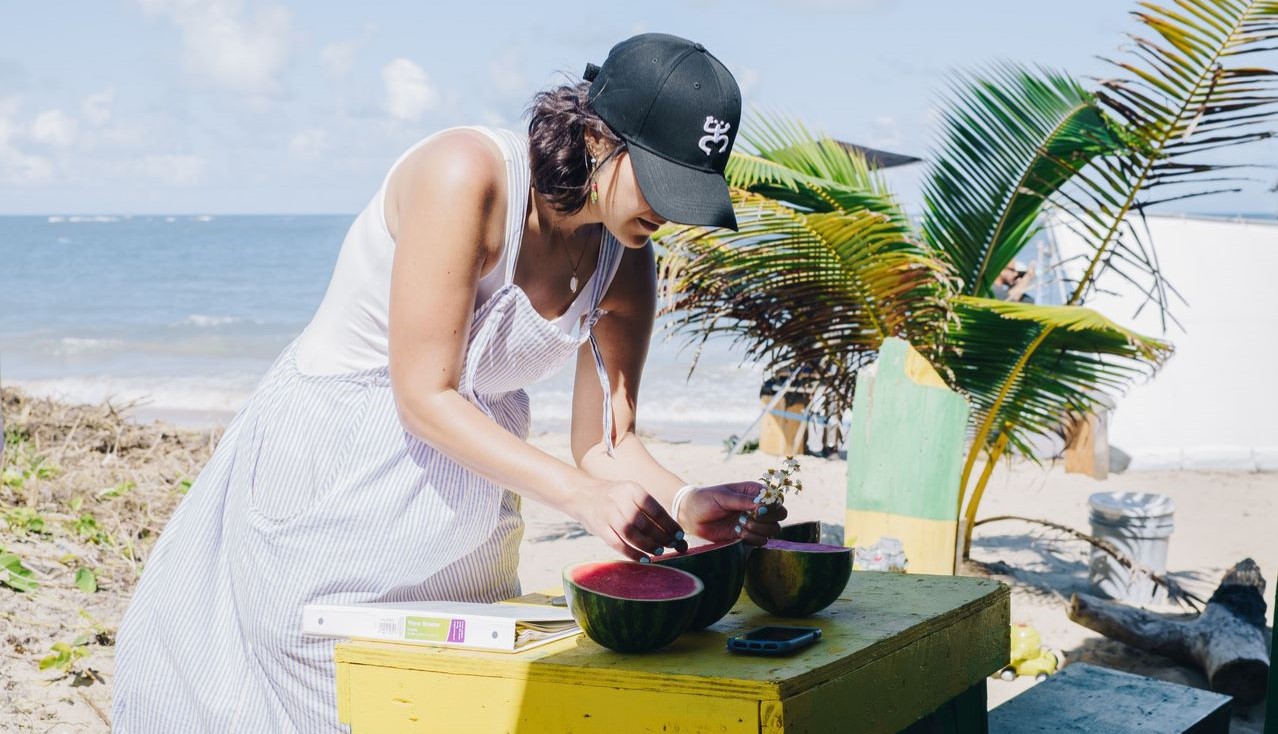
Morales wrote the screenplay for the vivid scene in which Yanise’s grandmother teaches her how to place pennies, flowers, and molasses on a sliced watermelon as an offering to Yemayá. In preparation for writing this ritual scene, Morales spent seven days connecting deeply with Yemayá, researching how she is talked about and represented in art. The scene mirrors moments Morales has experienced with her own grandmother and was created with the intention of offering something meaningful to audiences who never had the chance to learn directly from their elders.
The scene, originally much longer, had to be cut down several times in the editing room. Though it felt discouraging at first, this process eventually became illuminating. Morales says, “I realized that it didn’t need to be whole. That when you’re sitting with your grandmother or any elder who’s passing on cultural traditions, they don’t give you all the information at one time. It comes out in the trickle of everyday moments…If this film was actually going to be a new cultural form for delivering the things that we didn’t learn from our elders, then we had to allow it to mimic real life more and not be a dissertation, but instead leave you wanting to know more.”
Another creative decision made by Morales and Garcia in Daughter of the Sea was updating what Yemayá might look like. The image Morales grew up with is a white lady with straight, black hair emerging out of the ocean with pearls falling from her hands. In the film, that image was reclaimed as a Black woman in efforts to decolonize and confront the ways in which Eurocentric norms have distorted African spiritualities.

Looking ahead, Morales and Garcia have some exciting upcoming film projects. Acapulco Gold is a pan-Caribbean sports comedy that follows the journey of a young woman who has spent her life doubting herself. Through an unexpected turn of events, she gets the chance to train for the Olympics. Though a comedy, the film carries a political layer: the Olympic stage is one of few global venues where Puerto Rico is recognized as its own nation—allowing Puerto Rican athletes to compete against, and even defeat, the United States, its colonizer. Morales was awarded a 2024 Philadelphia’s Cultural Treasures project grant and will participate in a Stowe Story Labs program to develop the script for Acapulco Gold.
Another upcoming film, Casa de Luz, is a feature-length narrative film that centers on three generations of women in Puerto Rico who are estranged from each other, ultimately finding love and reconciliation. The presence of Oshun, the Orisha associated with love, is central to the film, as the characters call her in and live alongside her in daily moments. The film is expected to begin production in Puerto Rico in late 2026 or early 2027.
Morales feels deeply that folklore and traditional arts have an important role in the future. “To me, making films that are anchored by traditional knowledge are films about the future,” she says. “I am committed to tradition because it is inherently futuristic. Maybe that feels unlikely, because people talk a lot about the past when they talk about tradition. But I was taught that tradition is the ‘creation of the future out of the past’ and it is the aspect of tradition I like to pay attention to. It is what makes it urgent, relevant, and worth tending.”
*Featured Image: Image of Selina Morales on the set of Daughter of the Sea. Photo credit: Mari Robles.

Sophia Pradhan is a Malayali American artist and arts administrator whose writing explores film at the intersection of cognition, futurism, and speculative imagination. She is especially drawn to cinema that centers memory and ancestral knowledge to envision liberatory futures, with a focus on South Asian and diasporic filmmakers. Sophia is a 2026 cinéSPEAK Philly Cultural Critics Fellow.